

Getting it right: Meddling with sources

This week I was reading a story by CNN’s Daniel Dale about a denial President Trump made in which “he wrongly asserted he hadn’t said something he had said in a public forum.” This doubling down over creative truths told and retold reminded me of this piece I wrote in October 2022 — inspired by factchecking in Trump’s first term as president. I decided to publish it. (I took the photo of late newspapermen Mel Morris (L) and Allan Fotheringham at a party in 2009.)

__________________________

During the presidency of Donald Trump, factcheckers at news organizations became somewhat celebrated, elevated in the public arena to dedicated falsehood hounds sniffing out his lies while protectively pushing back against his accusations of manufacturing “fake news.”

Daniel Dale, the Toronto Star newspaper’s Washington bureau chief, started monitoring Trump early during the 2016 presidential election campaign. He had diligently chalked up a total of 5,276 Trump fibs by mid-2019 when he was scooped up by CNN to continue in a high-profile role at the U.S. news network factchecking Trump.

A few days after Trump’s presidency ended in January 2021, Washington Post factchecker Glenn Kessler reported that Trump had made 30,573 false or misleading claims during his time as president.

He was fair game — as the President of the United States, his lies held huge significance for national security, international diplomacy, the economy, stock markets and ultimately the integrity of democratic freedom.

Dedicated factchecker roles were required at newspapers due to the sheer volume of Trump’s lies and the need for journalists to be able to cover the president without simply repeating them.

At newspapers and wire services, factchecking has typically been the responsibility of the reporter writing the story and an editor. It was not usually a specific job or considered an illustrious role. 

Magazines often do have dedicated factcheckers, who review a story that has been edited, to ensure that all facts are correct. When I started out as a factchecker in 2000, an editor told me that there were a few reasons the factchecking process was critical. At the time, newsmagazines, particularly Maclean’s, were made available as a courtesy for patients to read in waiting rooms in medical and dental offices.

Unlike newspapers where a correction can be run the next day, magazines can lie around for years, so it is extra important they are accurate, the editor said. Another wild-card risk was that a writer or editor had indulged in a boozy lunch or dinner, and was operating under the influence, mixing things up and introducing errors.

In the mid-1980s factchecking was fleetingly popularized by the protagonist in Jay McInerney’s novel Bright Lights, Big City. An aspiring writer, he worked in the “Department of Factual Verification” at a New York City publication. On a downturn, which manifested in a destructive drug and alcohol binge, he confronted personal and professional demons, partly related to a marriage breakup and made that much worse by days spent in the office chasing and confirming facts.

But there is another side of this coin.

Journalists are responsible for factual accuracy, but the newsroom mantra has typically been that subjects should not be allowed to review — let alone alter — their work. Various style guides detail ethical principles. The Canadian Press Stylebook says it is verboten to buckle to the dictates of external sources.

“The Canadian Press does not permit interview subjects to review material gleaned from the interview — individual quotes, drafts, photos, audio or video clips — prior to publication,” the book says. “The practice of granting prominent officials the chance to review and edit their own quotes in exchange for an interview is an insidious one and should never be agreed to by a Canadian Press reporter.”

Maybe.

But some nonfiction authors argue there are additional benefits to reviewing drafts with sources, such as building trust and ensuring the full sense of the story is accurate and complete. Exploring the pros and cons of sharing material with sources in conversation with journalists revealed that the ground rules and limits a writer should impose on the nature of the subject’s relationship with the final story may shift according to context.

Lee Gutkind, founder of the literary journal Creative Nonfiction and author of You Can’t Make This Stuff Up: The Complete Guide to Writing Creative Nonfiction–from Memoir to Literary Journalism and Everything in Between, says that one way to protect sources while allowing them to defend themselves — is for writers to share what they have written with them before publication.

“Few writers go to this trouble, but sharing your narrative with the people about whom you’re writing doesn’t mean you have to change what you say about them; it only means that you’re being partly responsible to your characters and their stories,” he writes, adding that he does not let them have the hard copy.

Old school and new school

Kamal Al Solaylee, the director of the School of Journalism, Writing, and Media at Canada’s University of British Columbia (UBC), is at the heart of a debate on the topic. In addition to publishing three creative nonfiction books, Al Solaylee has worked at Canada’s Globe and Mail and other newspapers and magazines. The rules that dictate that a journalist should never share a story with a source were made in a context where there was an equal power dynamic, he said during a Zoom call.

The conversation he is involved in at UBC on the relationship between writers and sources is about sharing stories with vulnerable communities before publication, as he mulls the curriculum for a new course called Reporting in the Community.

“There’s a valid case to be made when reporting on very vulnerable communities in taking into consideration the power that you have as the storyteller and the audience that you have,” he said. “I don’t think I will ever get to the point where I’m going to send my story to a source and say, ‘Is it okay, can I go ahead and publish this?’.”

For his book Brown: What Being Brown in the World Today Means (To Everyone), he conducted in-depth interviews with more than 100 people in 10 countries about their experiences, recording his conversations.

The book would never have been published if he had gone back to check with each person he spoke with, he said, explaining that since he always records interviews, there was typically no need to go back to a source, unless he felt something remained unclear.

“There is just no mechanism in Canadian publishing or in publishing in general, to factcheck a book to that level of detail,” he said.

He discussed up front with everyone the purpose of the interview, explicitly explaining it was for publication in a book. If there’s anything you don’t want to say, then just don’t say it, he told them.

A complex dynamic

Linden MacIntyre, who has published three nonfiction and six fiction books, distinguishes between factchecking and what he refers to as consultation.

In a telephone interview, MacIntyre, who was host of the CBC investigative news program The Fifth Estate for almost 25 years, said that factchecking is an important part of the process, consultation can be critical, but that he does not share his work with sources.

On the side of the author, the motivation is simply to tell a story with universal relevance, but the person who is central to the story may not fully understand the perspective of the author.

“It’s in the achievement of this — or the attempt to get that kind of universality from a particular situation — where the divergence in interests will occur,” MacIntyre said. “If I’m honest, and if I’ve got any ability, the perspective is absolutely legitimate from the point of view of the journalist, whereas it’s probably disappointing to the subject.”

This tension cannot be resolved, creating an awkwardness about journalism. “You make these near intimate connections with people to do the story but in the back of your head, you realize that there will be a sort of a separation at a certain point — it may come before the product is finished or it will probably come after the product is completed,” he said.

“That can be kind of difficult because I always had lurking in the back of my mind this person who is placing so much hope on the outcome of this relationship that that I know is a fleeting thing and this person has such hope that this project will never meet — never fulfill — the hopes of that person and so there will be this inevitable disappointment.”

For book projects where the relationship is more extended, it can grow into a more intimate connection almost as if writer and subject are on a shared mission.

“It’s extremely unnerving, if at a certain point near the end of it, or afterwards, that this person feels betrayed,” MacIntyre said, explaining that for his current project he tends to keep the source in the loop regarding discoveries. “It’s a delicate dance, it’s at the core of the whole thing — this whole matter of trust, you have to trust your sources, they have to trust you — you have a transactional relationship, and you want the transaction to carry on.”

“It is murky, and there cannot ever be a hard and fast policy — if it comes down to judgment calls, you have to hope that your judgment is well informed and ethical,” he said.

The regular editorial oversight process should easily accomplish the usual safeguards against factual inaccuracy and ethical concerns, MacIntyre said, reiterating that the relationship between a journalist and a source and the mainstream media must always be based on the understanding that there are differing agendas.

“The journalist’s interest in somebody’s story is not because they’re particularly interested in the person, they’re in it because the person represents something that is of universal importance.”

It is a difficult situation that comes down to gut feelings, ethical attitudes, and the sense of your own personal responsibility to somebody else.

Marking the parameters

Sources are owed an up-front discussion that explains the rules of the game, said Jack Hart in his book Storycraft: The Complete Guide to Writing Narrative Nonfiction. He cites a 1989 two-part series written by Janet Malcolm in New Yorker magazine.

Her thesis makes a point similar to MacIntyre’s about the relationship between journalist and source. Published as a book titled The Journalist and the Murderer, the argument she makes is that the relationships narrative reporters forge with sources are a form of seduction that often lead to betrayal.

“The fact is that inherent contradictions color relationships between journalists and their sources, contradictions that narrative nonfiction writing often magnifies,” she states. “The problem is that writers and sources often bring contradicting expectations to a narrative project. Sources bring everyday social norms to the relationship, presupposing sympathy and loyalty. But for a reporter, sources are means to ends.”

Through transparency and by describing your role as a writer and how it might differ from what sources expect, they will become part of the process.

Wanda Taylor, author of The Nova Scotia Home for Colored Children: The Hurt, The Hope, and The Healing, about former residents launching a class action lawsuit alleging sexual and physical abuse over several decades, confronted a challenge when some of the staff at the orphanage made interviews conditional on reading the draft of her book.

She mulled it over and decided not to go ahead with interviewing them because she felt they would want to try and influence the focus of the story so they could try and make themselves look good, she said during a telephone conversation.

However, in general, she believes there is no right or wrong.

“I think it’s circumstantial,” she said. “I always want to err on the side of being cautious of those landmines — risking them wanting to change a story or changing their mind.”

To avoid simply parachuting in and extracting what is needed from them, Taylor establishes the ground rules ahead of time, discussing everything she thinks may arise to avoid re-traumatizing sources.

“I do everything on the front end so that there’s no need for me to go back, but also the other part is that I make sure that I’m 100 percent clear about what my intent is, what the story is, and then it’s a discussion,” she said.

She does not share a draft before publication, although she has also gone back to vulnerable communities on occasion to discuss possibly contentious issues.

Letting the vulnerable review

Katy Reckdahl, a senior reporter at non-profit Verité News in New Orleans, has covered communities struggling in the aftermath of Hurricane Katrina, which in 2005 as one of the most powerful storms ever to hit the United States killed 1,800 people, also shares with sources who have not had dealings with the media before publication, although editors have typically told her not to do it.

“There’s a principle among editors to not show anything to your sources — that that’s somehow not the way to do it,” she said during a telephone interview. “I don’t generally show the whole piece to somebody — but I’ve done it occasionally, if it’s really, really a very personal thing.”

She has never had a source demand big changes, but they have sometimes caught an error that she made inadvertently or clarified a really important piece of information.

If she is writing and thinks about the mood of a source who may express strong feelings, she will go back and ask if they still feel the same way.  

“I think that young reporters love ‘gotcha’ kind of quotes where somebody calls somebody out and there’s going to be somebody who may get mad when they read the piece, but I think that when you get older, you realize that life doesn’t need to be so oppositional all the time,” she said.

Just think about when news organizations were first set up, she said. “Most of the time it was white guys talking to white guys. The whole good old boys’ network has always covered each other’s asses. I just feel like that power structure is built into journalism. And if I’m going to do journalism the way I want to do journalism, I’m going to have to make sure that the people who tell their story have power over the story.”

After the fact

As a former factchecker myself for five years at the turn of the century, mainly at Maclean’s, Canadian Business and MoneySense magazines, I am quite familiar with the process of chasing up and confirming the details and minutiae to ensure stories written by others are correct before they go to press.

At that time, although computers and the Internet existed, and we searched it to confirm facts, we also had to rely on clipping files, periodicals and books. The painstaking process involved printing out the story, using a highlighter pen to mark up all the facts and then striking off word-by-word with a pencil as they were verified.

In some instances, journalists provided supporting documents for their claims, but in others they did not. This meant re-reporting the story from scratch, often an even more time-consuming process than writing it in the first place. The challenge was compounded if editors had rewritten a story, reframing its original content and meaning.

The best I could hope for, as a freelancer working a couple of days a week, was that I would get to check a proper feature story written by a senior journalist about a topic I was interested in, rather than the news or entertainment briefs.

More seasoned journalists such as the late Allan Fotheringham, who was known for his acerbic wit and his back-page column at Maclean’s, tolerated being factchecked and apparently at times even got a kick out of it.

Whenever I saw him, Foth, as he was known by his friends, always chuckled about the time I checked one of his columns in November 2000. It was about journalist Michael Valpy — now retired, but formerly a columnist at Toronto’s Globe and Mail newspaper — who was running for Parliament in Toronto’s Trinity-Spadina constituency as a New Democratic Party candidate.

We spoke by telephone, and I pointed out a few minor inaccuracies — one to do with the circumstances surrounding the death of Italy’s fascist dictator Benito Mussolini, who was also a journalist. He acquiesced without argumentation to my suggested changes.

 “Just get rid of that widow, will you?” he said as our call neared its end.

“What widow? I don’t see anything about a widow here.” I replied, my pencil hovering over the printed page as I searched for the word to strike off.

He laughed at my naivety, explaining that a widow is a single word at the end of a sentence hanging by itself on a line, not a reference to one of the journalists who had run as political candidates and failed, mentioned in the column.

Only two — Britain’s former Prime Minister Winston Churchill and Quebec’s former sovereigntist provincial Premier René Lévesque — were successful, the column argued.

A particularly challenging task was to check the quotes in a story. Factcheckers were supposed to confirm that the source quoted had said what was being attributed to them, that the meaning was accurate, but by no means was any part of the story or any quote to be read back verbatim to avoid interference from the subject.

It was difficult to predict how a subject might react.

A case in point was the time I factchecked a story about Hollywood actor Peter Dinklage. Now known mainly for the part he plays as Tyrion Lannister on the television show Game of Thrones, back in 2004, he was a rising star due to a leading role in the film The Station Agent, which was released the year before.

The story mentioned that Dinklage had dwarfism related to a medical condition. As I ran through those details with him over the phone, he became enraged, shouting at me and hanging up. I went back to tell the writer, who by then had received a complaint from an editor, who had received a call from an angry publicist.

 The story — as I recall it — was subsequently killed by the editor.

References

Dale, Daniel. “The first 5,276 false things Donald Trump said as U.S. president,” Toronto Star, June 2, 2019. https://projects.thestar.com/donald-trump-fact-check/

Fotheringham, Allan. “A Passionate Politician.” Maclean’s. November 27, 2000. https://archive.macleans.ca/article/2000/11/27/a-passionate-politician

Gutkind, Lee. You Can’t Make This Stuff Up: The Complete Guide to Writing Creative Nonfiction — from Memoir to Literary Journalism and Everything In Between. Boston: Da Capo Press/Lifelong Books, 2012.

Hart, Jack. Storycraft: The Complete Guide to Writing Narrative Nonfiction. Chicago: Chicago Press, 2011.

Kessler, Glenn. “Trump made 30,573 false or misleading claims as president. Nearly half came in his final year.” Washington Post. January 23, 2021. https://www.washingtonpost.com/politics/how-fact-checker-tracked-trump-claims/2021/01/23/ad04b69a-5c1d-11eb-a976-bad6431e03e2_story.html

McCarten, James. The Canadian Press Stylebook: A Guide for Writers and Editors. 18th edition. Toronto: The Canadian Press, 2017.

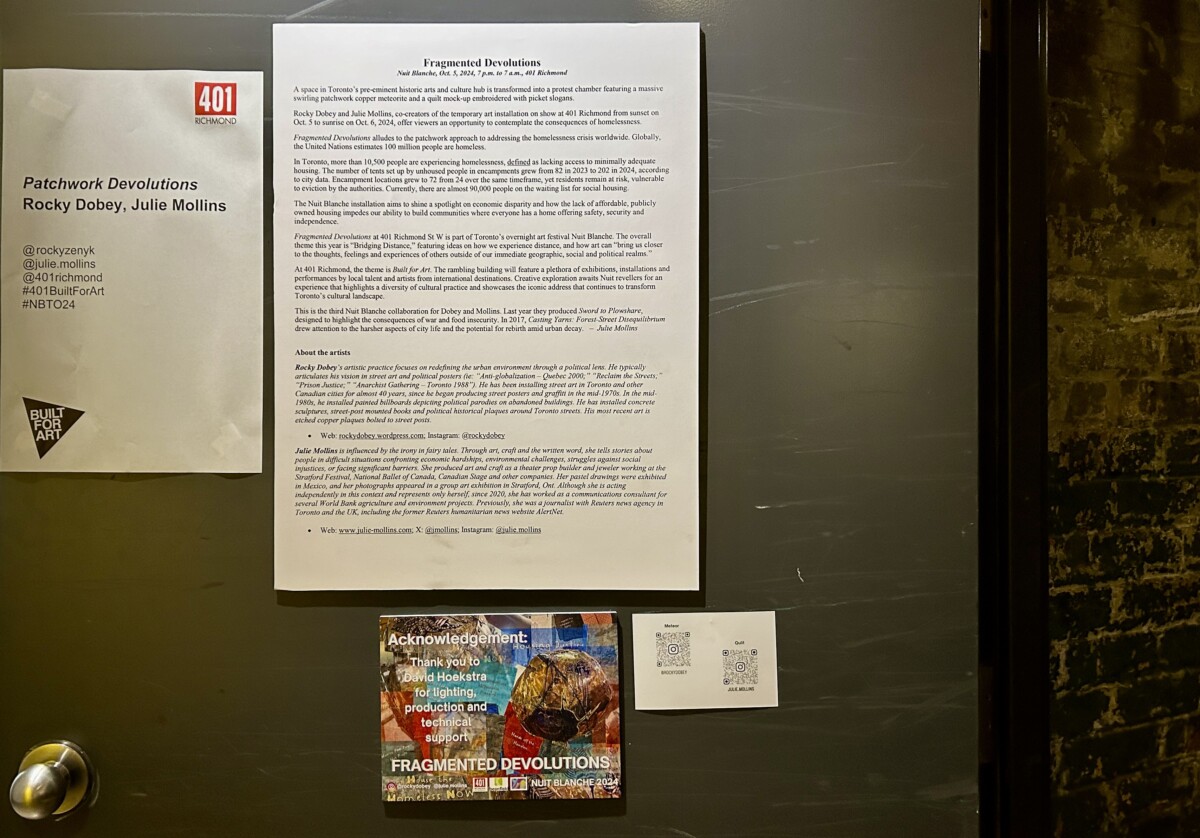
Nuit Blanche 2024: Fragmented Devolutions

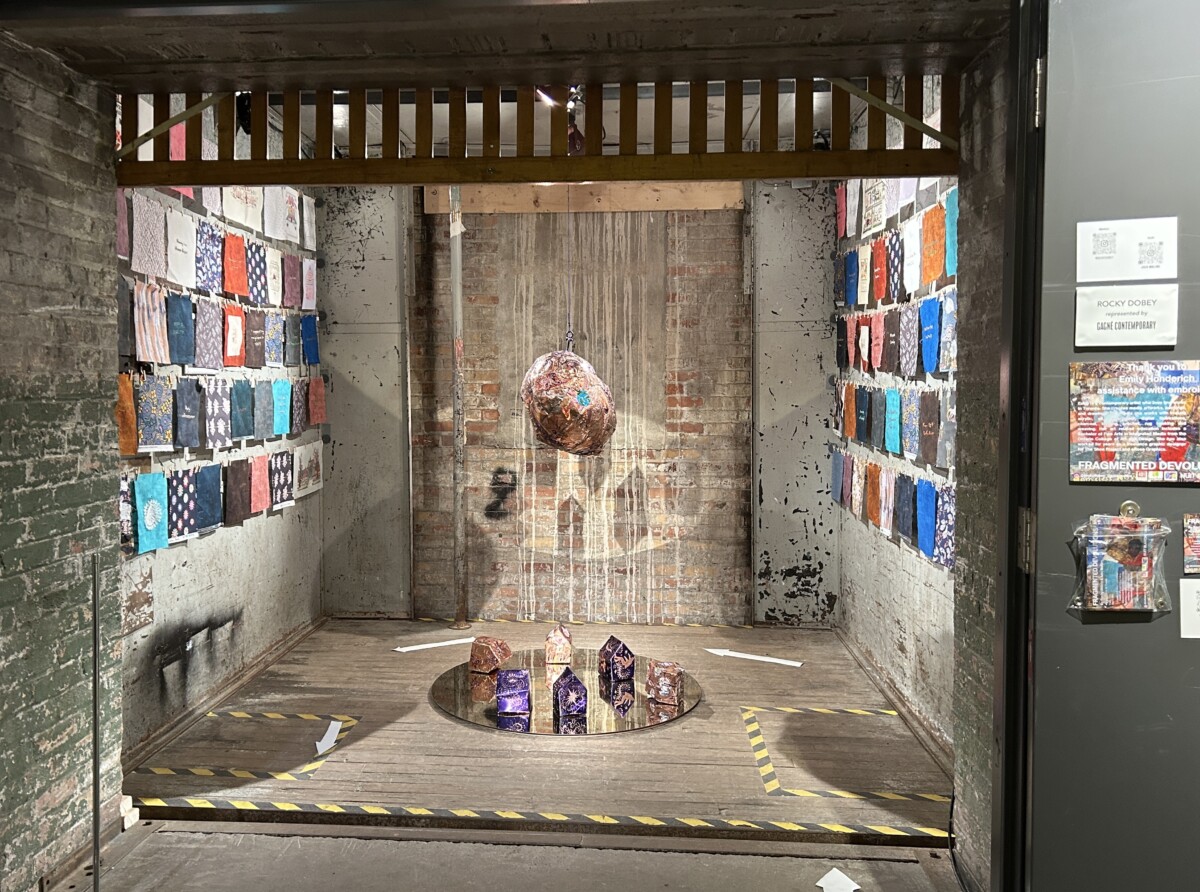
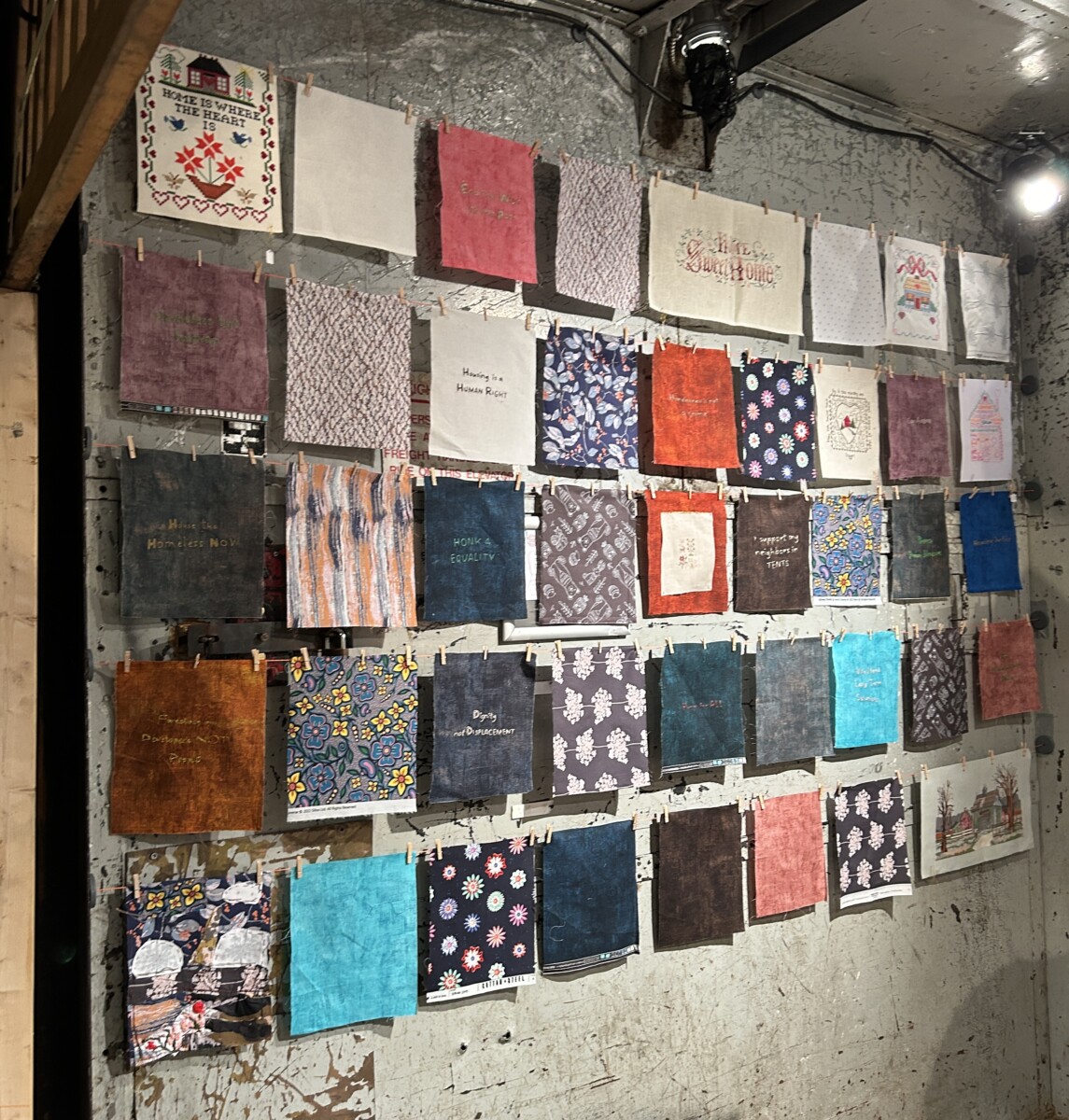
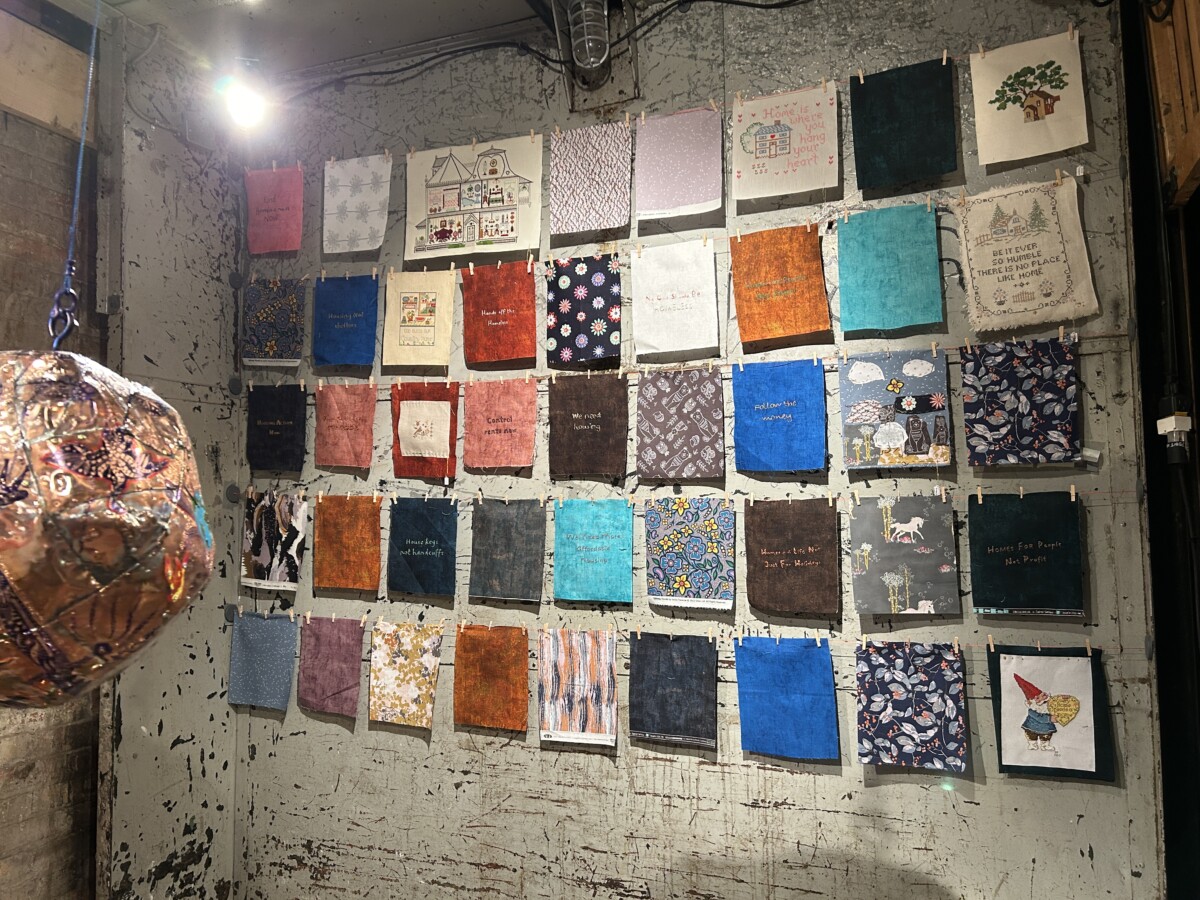
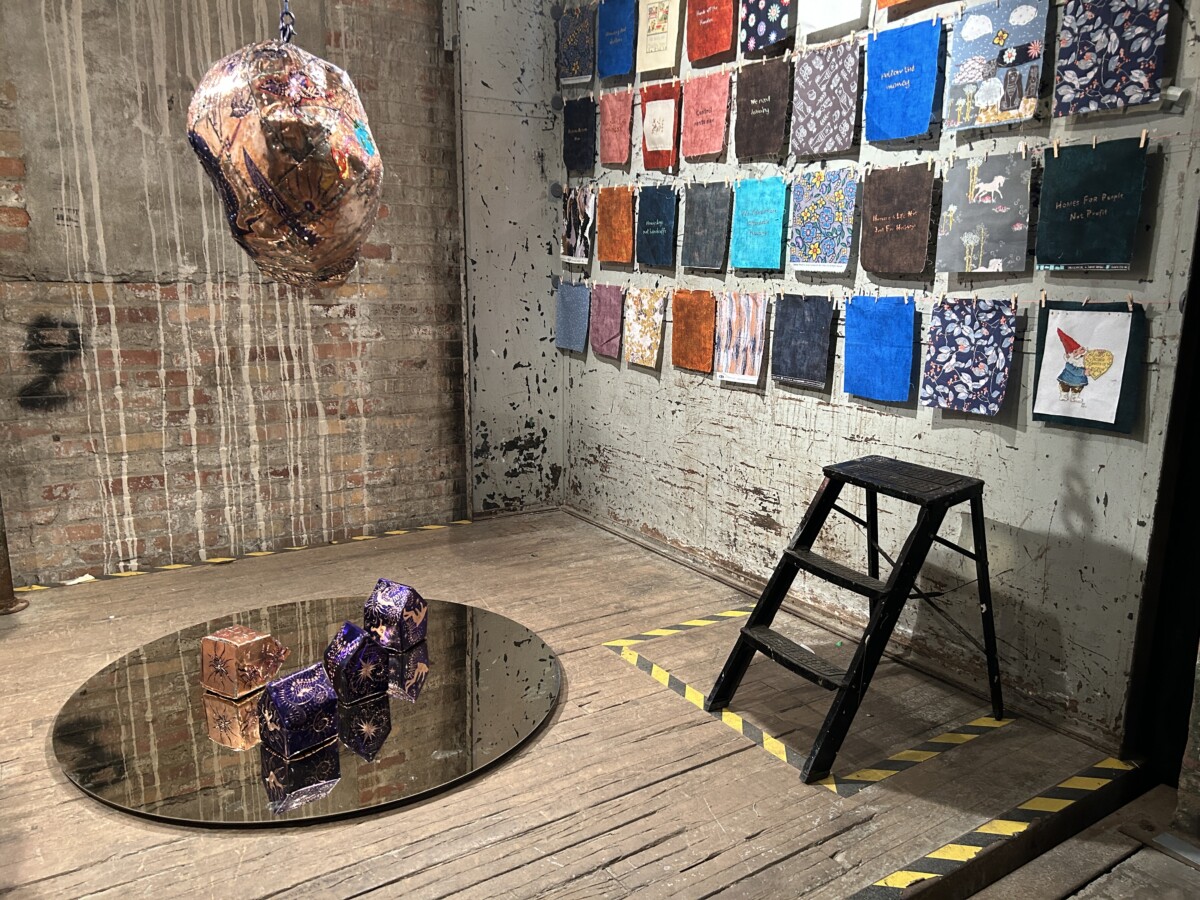
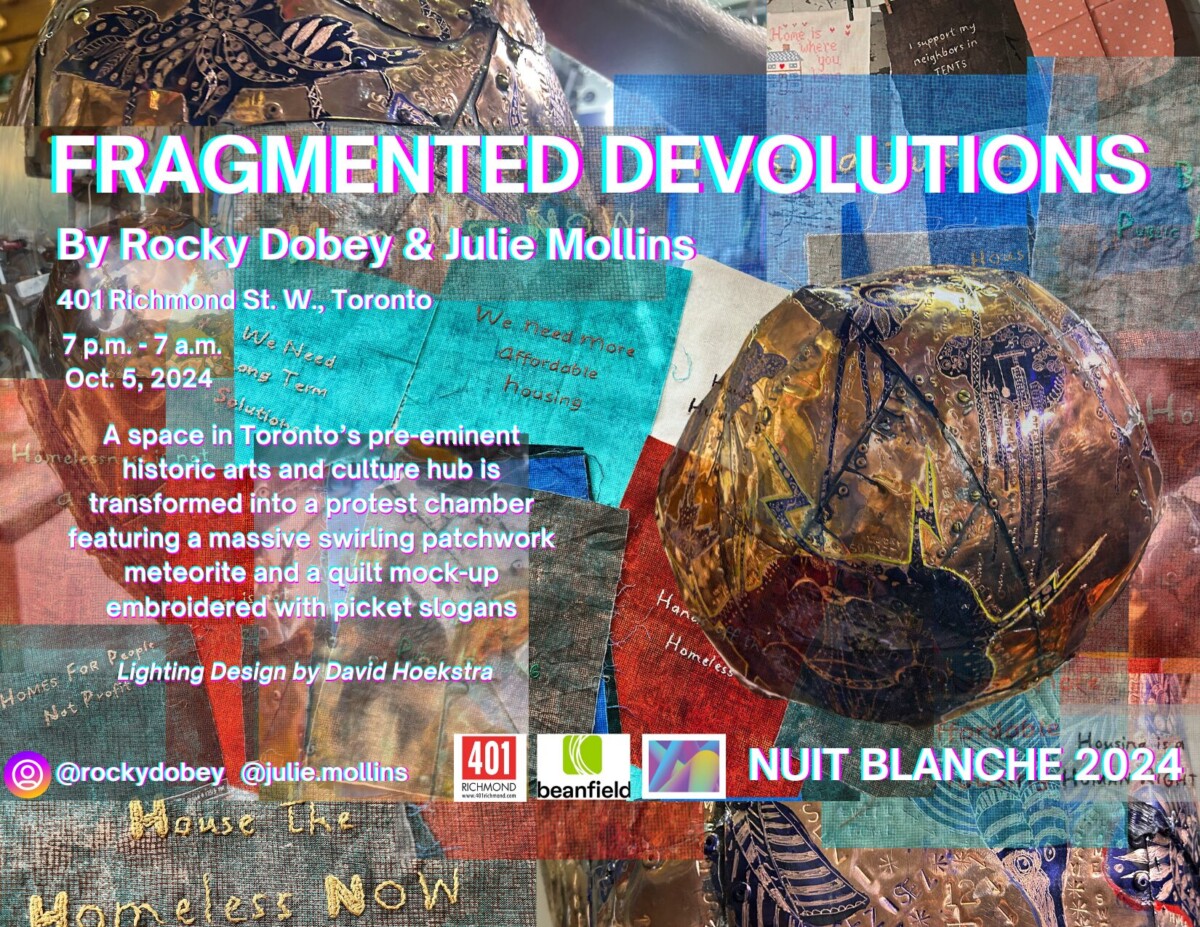
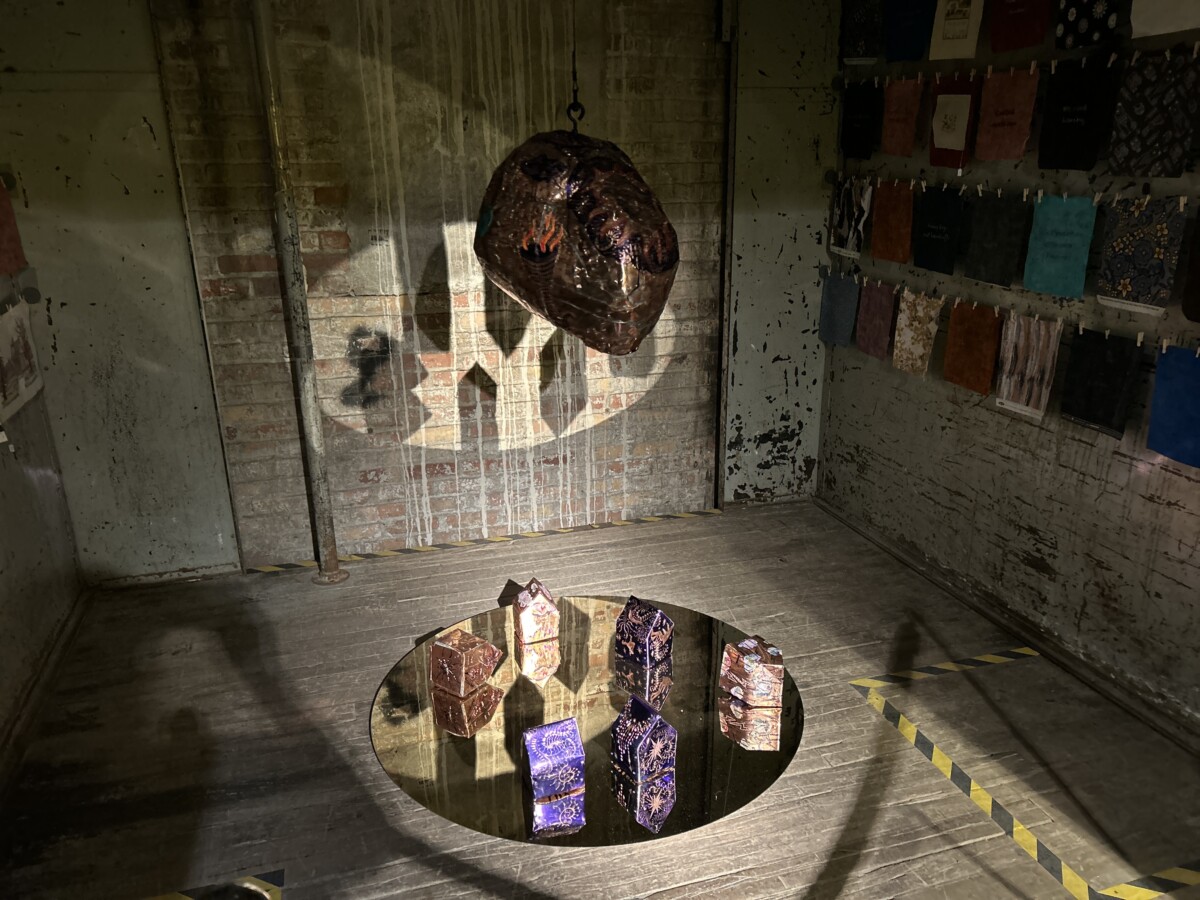
TORONTO (Sept. 26, 2024) – A space in Toronto’s pre-eminent historic arts and culture hub will be transformed into a protest chamber featuring a massive swirling patchwork copper meteorite and a quilt mock-up embroidered with picket slogans.

Rocky Dobey and Julie Mollins, co-creators of the temporary art installation on show at 401 Richmond from sunset on Oct. 5 to sunrise on Oct. 6, 2024, offer viewers an opportunity to contemplate the consequences of homelessness.

Fragmented Devolutions alludes to the patchwork approach to addressing the homelessness crisis worldwide. Globally, the United Nations estimates 100 million people are homeless.

In Toronto, more than 10,500 people are experiencing homelessness, defined as lacking access to minimally adequate housing. The number of tents set up by unhoused people in encampments grew from 82 in 2023 to 202 in 2024, according to city data. Encampment locations grew to 72 from 24 over the same timeframe, yet residents remain at risk, vulnerable to eviction by the authorities. Currently, there are almost 90,000 people on the waiting list for social housing.

The Nuit Blanche installation aims to shine a spotlight on economic disparity and how the lack of affordable, publicly owned housing impedes our ability to build communities where everyone has a home offering safety, security and independence. 

Fragmented Devolutions at 401 Richmond St W is part of Toronto’s overnight art festival Nuit Blanche. The overall theme this year is “Bridging Distance,” featuring ideas on how we experience distance, and how art can “bring us closer to the thoughts, feelings and experiences of others outside of our immediate geographic, social and political realms.”

At 401 Richmond, the theme is Built for Art. The rambling building will feature a plethora of exhibitions, installations and performances by local talent and artists from international destinations. Creative exploration awaits Nuit revellers for an experience that highlights a diversity of cultural practice and showcases the iconic address that continues to transform Toronto’s cultural landscape.

This is the third Nuit Blanche collaboration for Dobey and Mollins. Last year they produced Sword to Plowshare, designed to highlight the consequences of war and food insecurity. In 2017, Casting Yarns: Forest-Street Disequilibrium drew attention to the harsher aspects of city life and the potential for rebirth amid urban decay.

With embroidery assistance by Emily Honderich and lighting design by David Hoekstra.

About the artists

Rocky Dobey’s artistic practice focuses on redefining the urban environment through a political lens. He typically articulates his vision in street art and political posters (ie: “Anti-globalization – Quebec 2000;” “Reclaim the Streets;” “Prison Justice;” “Anarchist Gathering – Toronto 1988”). He has been installing street art in Toronto and other Canadian cities for almost 40 years, since he began producing street posters and graffiti in the mid-1970s. In the mid-1980s, he installed painted billboards depicting political parodies on abandoned buildings. He has installed concrete sculptures, street-post mounted books and political historical plaques around Toronto streets. His most recent art is etched copper plaques bolted to street posts.

Julie Mollins is influenced by the irony in fairy tales. Through art, craft and the written word, she tells stories about people in difficult situations confronting economic hardships, environmental challenges, struggles against social injustices, or facing significant barriers. She produced art and craft as a theater prop builder and jeweler working at the Stratford Festival, National Ballet of Canada, Canadian Stage and other companies. Her pastel drawings were exhibited in Mexico, and her photographs appeared in a group art exhibition in Stratford, Ont. Although she is acting independently in this context and represents only herself, since 2020, she has worked as a communications consultant for several World Bank agriculture and environment projects. Previously, she was a journalist with Reuters news agency in Toronto and the UK, including the former Reuters humanitarian news website AlertNet.

David Hoekstra is an acquisitive props master and builder for hire whose work has been seen in almost every theatre throughout Toronto over the last 30 years. David has also been the props master for George Brown College Theatre School since 1997. Known for his extensive collection of antique electric toasters, David also restores vintage stage lights and has a fondness for ray guns.

Emily Honderich is a contemporary artist who lives and works in Toronto. She creates media artworks, paintings, and drawings. The media she works with include acrylic, oil, watercolour, digital illustrations, charcoal, knitting, crochet, rug hooking and weaving. Her art related education includes a Bachelor of Fine Arts in Integrated Media from the Ontario College of Art and Design. She has also worked for years as a freelance graphic designer for The Shoe Project and eRose Graphics.