Category Archives: ruminations

Obituary for Lily Tagg

TAGG, Lily (NEE FOREMAN)

Passed away May 1, 2012 age 90 in Maidstone Hospital after a brief illness.

Lily, born in Cranbrook, Kent, on August 9, 1921, lived in Staplehurst, then Maidstone where she was working as a “clippy” bus conductor during the Second World War when she met her future husband Joe Parkes, a coal salesman.

Moving to London in 1947, she worked as a housemaid, marrying Joe in 1950. Lily later became a telephonist and supervisor with the General Post Office, a career carried to Maidstone from London’s Bayswater and Sloane Square exchanges, after she and Joe moved in 1965 to nearby Barming.

In 1978, almost 10 years after Joe’s death from tuberculosis in 1969, Lily married his cousin Rob Tagg with whom she enjoyed four years before being widowed a second time.

Throughout her career and after retirement in 1981, dear Lily created happiness and often helpfulness for colleagues, neighbours, friends and kin, including her late brother Fred Foreman of Maidstone.

She enjoyed driving in the Kent countryside, walking her dog Prince by the River Medway and dog-sitting for neighbours in Barming’s Beverley Road Estate.

Amid the deep sadness at her passing, Lily shall be ever warmly remembered by many who knew her.

A funeral service will be held on Thursday, May 17, 2012 at 12:30pm at Vinters Park Crematorium in Maidstone followed by interment at St Margaret of Antioch, Barming parish church, at a later date.

Donations can be made by cheque in Lily’s memory to Guide Dogs for the Blind c/o Family Funeral Service, 6 Marlborough Parade, Beverley Road, Barming, Maidstone, Kent, ME16 9JN or directly to the organisation.

Family flowers only, please.

I wrote this obituary for my aunt. It was originally published in the Kent Messenger.
Wollstonecraft’s “Vindication” at 220 years old


Mary Wollstonecraft‘s book “A Vindication of the Rights of Woman” was published 220 years ago this week on February 23, 1792. It posits that women are entitled to a proper education and to the same rights as men.

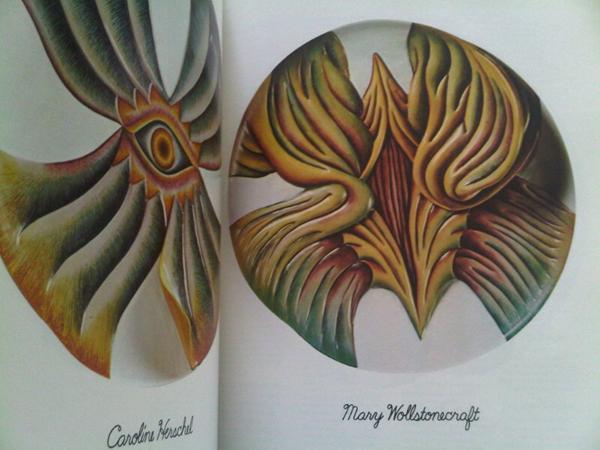
To mark the event, I took this photograph of a plate designed by the influential feminist artist Judy Chicago for “The Dinner Party” — a 1970s art installation — from an image in a book of the same name. The plate is a conceptualized image of 18th-century feminist Wollstonecraft.

Chicago’s 1979 book describes the art project, which took her five years to complete. At its core, Chicago’s “Dinner Party” art installation represented 39 significant real and mythological women as abstract designs on ceramic plates evoking vulvar and butterfly forms.

The interpretive works were set out on a triangular table and accompanying embroidered runners further illustrated important aspects of the women’s lives. Another 999 women of achievement were memorialized on the floor.

The women selected for representation in “The Dinner Party” were those who “had fought to make themselves heard, fought to retain their influence, attempted to implement or extend the power that was theirs, and endeavored to do what they wanted,” Chicago wrote.

“I thought images on plates would convey the fact that the women I planned to represent had been swallowed up and obscured by history instead of being recognized and honored,” wrote Chicago.

Chicago had originally conceived the art project as a series of 100 plates to be hung on a wall, but eventually decided to create a dinner party installation.

“Each woman is herself, but through her can be seen the lives of thousands of other women — some famous, some anonymous, but all struggling … to have some sense of their own worth through five thousand years of a civilization dominated by men,” Chicago wrote.

CHILDBIRTH & DEATH

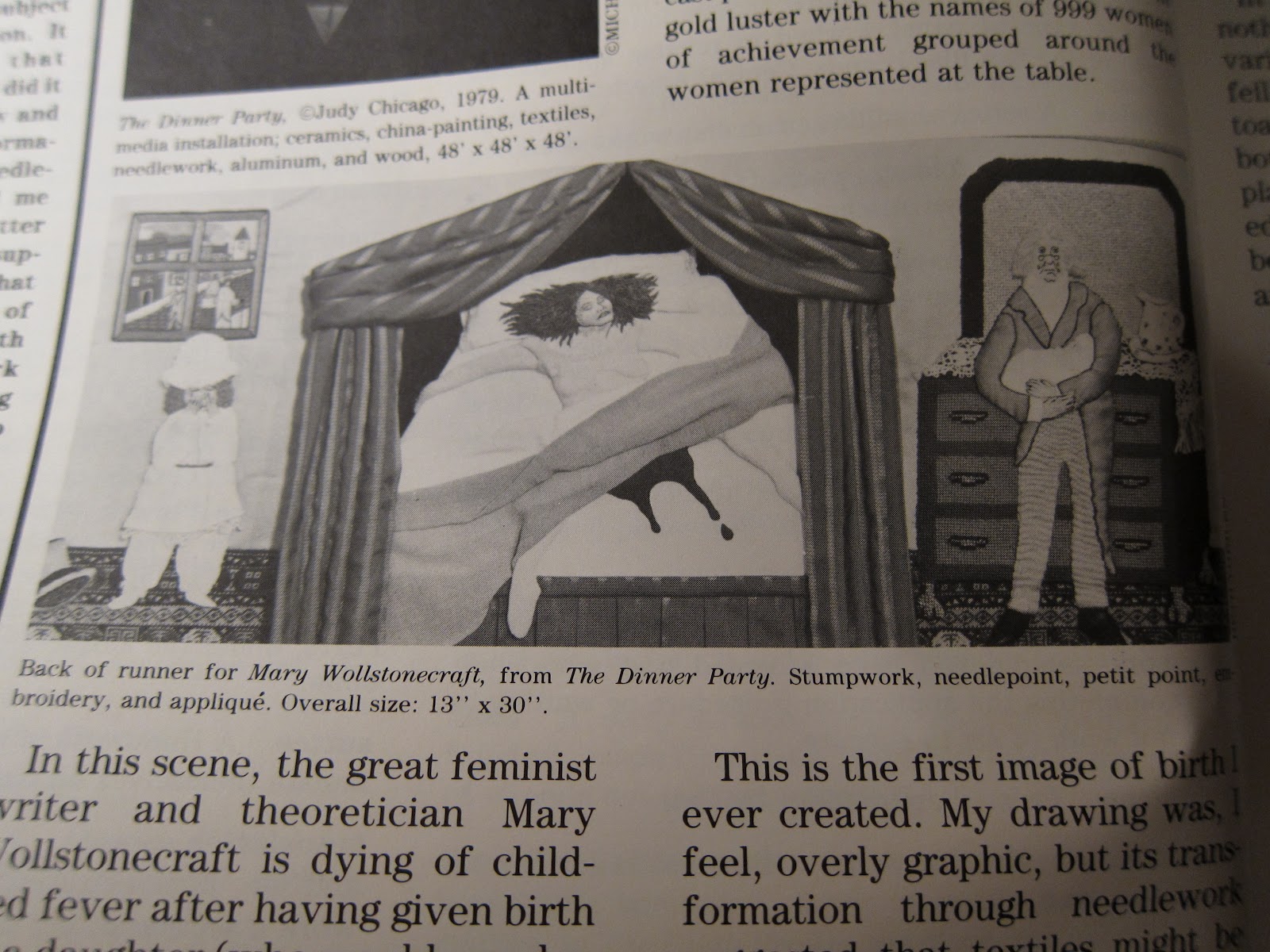
The picture below represents Wollstonecraft dying of childbirth fever after giving birth to her daughter Mary Shelley, who in adulthood wrote the novel “Frankenstein”.


“The Mary Wollstonecraft image for the back of the ‘Dinner Party’ runner prefigured my interest in the subject of birth and creation,” Chicago wrote in her 1985 book, “The Birth Project“.

“It was an image that frightened me when I did it because it was so raw and graphic,” Chicago wrote.

FEMINIST INFLUENCE

When I was primarily a painter and artist, I read Judy Chicago’s books, Wollstonecraft’s “Vindication”, as well as other feminist philosophy on art and women’s role in society in general. I also read a lot of women’s literature.

Virginia Woolf’s 1929 “A Room of One’s Own” stands out as the most memorable and serves both as a hub and framework for all the other ideas and concepts.